(NOTE: subject to change)
Professor: Ryan Garcia
Art 204, Tuesdays/Thursdays 3-5:50 PM, Broome Library 1760
Office Hours: by appointment, via class ZOOM
Course Web Site: https://art204.ryangarcia.cikeys.com & CI Learn
Email Contact: ryan.garcia@csuci.edu
Office Telephone: (805) 437-2615
Summarized Course Objectives:
Refine Digital Skills – Communicate through Visual Media – Develop Historical Sensibilities – Understand Design Issues and Software – Begin to Develop a Portfolio
Catalog Description:
Art 204 is an introduction to basic concepts in graphic design for print and electronic media. Projects incorporating traditional and digital media explore typography, layout, and visual design. Particular emphasis is on the development of fundamental skills leading to the ability to communicate ideas through the use of text and visual imagery. These skills are entirely modular and can be applied to web design, digital video, motion graphics, as well as an extensive range of visual fields.
Foreseeable Expenses:
Classroom printers are available for project use, but at times students may wish to have work printed professionally. Please plan your production accordingly. Projects will be established with the “student budget” in mind. Supplies include:
- Off-campus printing, custom paper, and alternative stocks
- Blackboard/foam core, mounting materials, double-sided tape
- Exacto knives, blades, (Recommended: self-healing cutting board)
- Metal edged cutting ruler (12” or longer)
- 18 x 24” Newsprint Pad (used only for this course)
- Portable USB drive for assured file storage (highly recommended!)
Occasional Course Reading
There is no official course textbook, but several technical/software guides are available. See the instructor for recommendations. There will be regular readings and articles addressing class topics and contemporary design issues.
Primary Learning Outcomes:
At the Close of the Class, Students Will Be Able to:
- Demonstrate basic design principles in graphic design projects.
- Demonstrate proficiency with graphic design software program to produce basic projects.
- Articulate, verbally and in written form, their conscious intentions and coherent aesthetics in relationship to projects they produce.
- Develop a personal artistic/symbolic language expressed through the artistic process.
- Demonstrate methods and processes utilized in refinement of artistic ideas and technical issues.
- Demonstrate knowledge of design theory through the critical evaluation process.
- Develop artistic skills leading toward professional practice in the arts.
- Produce individual works of art.
- Develop a portfolio of work created in the course.
Course Concept:
What exactly is “design?” Or perhaps more appropriately, what is “graphic design?” There is a great deal of baggage attached to the term. Of course, for many individuals, the elusive promise of graphic design is simply a means to an end; a way to stay creative and still get paid. But is design inherently commercial? What constitutes a positive, useful, and lasting design? Is there a place in between commercial and non-commercial production where designers can maintain historical sensitivity, and meanwhile push their ideas into new territories?
This course offers an attempt to answer these and many other questions. Naturally, at the core level, we will explore design fundamentals and the visual communication principles behind effective graphic design. Efforts will be geared towards generating professional and sophisticated work, but at the same time, the course will be heavily oriented towards pure production. Not all projects will be destined for the portfolio; there will be an equal emphasis on smaller projects, rapid prototyping, generating rough comps, and “sketchbook-style” design. As always, keep in mind this class is a laboratory—not the industry. Here you have the opportunity to experiment and push your work into daring and innovative areas.
Supplemental Description:
This is the second course following the Digital Media Art trek designed for students seeking to expand knowledge and digital proficiency. As an intermediate course, Art 204 continues to build a necessary foundation by investigating a wide range of applications and issues. Through creative and challenging assignments, the course will not only address key historical and contemporary issues faced by graphic designers, it will also give students a deeper understanding of technological influences in a host of visually-driven fields.
It is expected that students have at least a basic level of knowledge in certain digital applications (including working knowledge of Adobe Photoshop), as well as a general understanding of navigating through the operating system on Macintosh computers. As specific courses build cumulatively, it is also not encouraged for students to concurrently enroll in prerequisite classes (such as Art 108).
Lectures, classroom discussions, technical tutorials, demonstrations, and critiques, will allow opportunities for expanded growth with an emphasis on building conceptually and technically solid work. As this is a studio course, class time will also be offered to work on projects and consult with the instructor. Though the class will be technical in nature, it is not simply a “software training” course. Once classroom tutorials end, students will be expected to conceptualize, problem-solve, and ultimately consider issues both inside and on the fringe of the industry. The brave challenge of the class will be for students to gain an understanding of digital tools in order to develop the highest quality work. Production will take place on Macintosh computers in the Broome Library #1760 computer lab.
Grading:
Large multi-faceted projects, small assignments, readings, written responses, in-class presentations, and possible quizzes should be anticipated at any given time. Students are expected to complete these challenges with confidence and often under tight deadlines. Failure to complete projects by the appropriate deadline will result in a significantly lowered grade.
A particular challenge of Art 204 is the number of assignments and the overall workload. This is a “production class” so be prepared for at least one small assignment per week, in the midst of larger projects. Some assignments will require quick responses while others will ask you to go through stages of completion. The overall goal is to develop a well-rounded approach to handling any situation that arises. All work must be presented in a professional manner.
A special note: Although this class will maintain a congenial attitude, students should expect to deliver and receive constructive peer and instructor criticism.
Work is generally evaluated on the following essential elements:
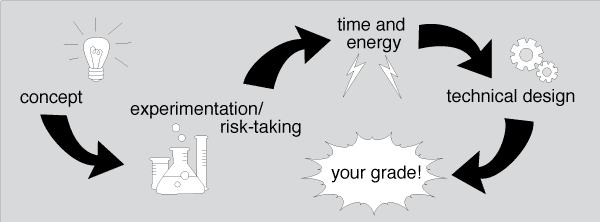
Please note that there is a continuing emphasis on the long-standing policy of the Cal State University system that grades should reflect a student’s actual achievements within the course in order to maintain the integrity of the overall program. What this really means is that even though I genuinely like every one of you, and I am sure you are great human beings, the University seeks to distinguish between levels of achievement. There are no formulas or tricks, just the work, and efforts that you put into this class. If you have questions about grades or progress you are welcome to ask questions at any time during the term, and similarly, you are encouraged to maintain a dialogue about grading concerns.
CSUCI Grading Policy
(The +/- system will be used):
- “A”: Student performance has been outstanding and indicates an exceptional degree of academic achievement in meeting learning outcomes and course requirements.
- “B”: Student performance has been at a high level and indicates solid academic achievement in meeting learning outcomes and course requirements.
- “C”: Student performance has been adequate and indicates satisfactory academic achievement in meeting learning outcomes and course requirements.
- “D”: Student performance has been less than adequate and indicates deficiencies in meeting the learning outcomes and/or course requirements.
- “F”: Student performance has been unacceptable and indicates a failure to meet the learning outcomes and/or course requirements.
- “CR” reflects the equivalent of a “C” or higher for undergraduate courses and the equivalent of a “B” or higher for graduate and post-baccalaureate courses (or as determined by the graduate program).
- “W” (Withdrawal): This symbol is used to indicate that the student was permitted to withdraw from the course after the third week of the semester with the approval of the instructor and appropriate campus officials. See withdrawal procedures in the Catalog.
- “WU” (Withdrawal Unauthorized): This symbol is used to indicate that an enrolled student did not formally withdraw from the course according to University policy and also failed to complete course requirements. It is used when, in the opinion of the instructor, completed assignments or course activities or both were insufficient to make normal evaluation of academic performance possible. For purposes of grade point average, this grade is equivalent to an “F.”
- “I” (Incomplete Authorized): This symbol shall be applied as stipulated in SP03-18. For this course, the Professor may add a “+” or “-” to any grade except “F”. By adding a “+” to a grade, the grade points earned shall increase by 0.3 (except that an A+ shall still be 4.0 grade points). By adding a “-” to a grade, the grade points earned shall decrease by 0.3.
Note: Satisfactory completion of assigned projects and materials will receive a letter grade of “C”; the letter grade of “A” is earned only in cases of exceptional work.
Approximate Course Breakdown:
- Attendance, Participation, Critique Involvement: 20%
- Reading, small assignments, and presentations: 30%
- Three general projects 35%
- Final Project: 15%
General Course Rubric:
Because so much attention, time, and anxiety surrounds the grading process, and because it is difficult to imagine where we will be sixteen weeks from now, this appendix is offered as a fairly accurate grading rubric that will be used to calculate course projects:
| A | B | C | D | |
|---|---|---|---|---|
| concept/ ideas |
Innovative; well thought-out; highly sensitive to course, current issues & historical trends; sophisticated; mature. | Interesting; sophisticated; clear ideas; relevant to current issues; some complexity, could use only minor tightening and refinement. | An adequate level of complexity; focused but perhaps vague; moderately insightful or relevant. | Immature; inappropriate material; unfocused; lack of any clear concepts or cohesive approach. |
| experimentation/ risk-taking |
Bold; challenging yet successful; decisive & intentional; pushes beyond the obvious or easily recognized. | Some level of appropriate invention; solid & refined; mildly innovative; pushes beyond obvious; fairly exploratory. | Meets expectations with some general exploration; only minor use of “color,” boldness, & variation. | Lacking uniqueness or significant level of authorship; straightforward; over-general; safe. |
| time and energy | Extremely high level of detail; very intricate; meticulous; clear evidence of time; color-correct; crisp & concise. | High level of detail; attention to subtleties; tight construction, free of printer errors; tidy, but a bit rougher around the edges. | Some detail; lacking real subtleties; meets basic expectations; less than professional, minor printer errors. | Lacking in neatness; lacking any details; poor construction; printer errors; “rushed” or cursory look. |
| technical design | Logical; utilizes course issues; free of any technical errors; expertly crafted; highly polished; near-suitable for publication. | Cohesive; highly refined with only very minor technical errors; well-crafted; sharp, successful use of applications. | Rough; contains possible technical errors; demonstrates only basic understanding of technical discussions. | Very rough; missing required design elements; mechanical errors; missing key course issues. |
General Dates and Projects (subject to change):
Weeks 1–5, Masking, Montage & Concept Design
Project 1: The Monster Mash
Weeks 6–8, Custom Type Design
Project 2: PSA Poster Design
Weeks 9–12, Multi-page Concept Design
Project 3: Retro Music Packaging
Weeks 13-16, Interface & Software Design
Project 4: “Designster”
Critiques:
Your time to shine−don’t show up empty-handed. The day the project is due you must be ready to present your work at the beginning of class. For sanity, we will likely break the discussion up over multiple classes. You can volunteer to discuss your work, and after volunteering, students will be picked randomly. Put together your best effort; the way you present your work will be part of the project grade. Finally, if you feel you have not received sufficient feedback, please come by my office hours and I will be glad to discuss your work at greater length.
Attendance:
Students are expected to attend class and any number of unexcused absences will affect final grades. Do not plan to leave early or arrive late. Three (3) unexcused absences will result in a lowered grade. Please let me know via email if you come down with a massive illness instead of skipping out for three weeks. In the event of unexcused absences, responsibility for making up missed material falls solely on individual students. Missed materials will NOT be covered in class. Excused absences will require an appropriate note from a physician.
For absences with extenuating circumstances related to a medical condition or disability for which you may require reasonable accommodation, please refer to the Disability Statement (below).
Disability Statement:
If you are a student with a disability requesting reasonable accommodations in this course, please visit Disability Accommodations and Support Services (DASS) located on the second floor of Arroyo Hall, or call 805-437-3331. All requests for reasonable accommodations require registration with DASS in advance of needed services. You can apply for DASS services on the DASS website. Faculty, students, and DASS will work together regarding classroom accommodations. You are encouraged to discuss approved accommodations with your faculty.
Academic Dishonesty:
By enrolling at CSU Channel Islands, students are responsible for upholding the University’s policies and the Student Conduct Code. Academic integrity and scholarship are values of the institution that ensure respect for the academic reputation of the University, students, faculty, and staff. Cheating, plagiarism, unauthorized collaboration with another student, knowingly furnishing false information to the University, buying, selling, or stealing any material for an examination, or substituting for another person may be considered violations of the Student Conduct Code. If a student is found responsible for committing an act of academic dishonesty in this course, the student may receive academic penalties including a failing grade on an assignment or in the course, and a disciplinary referral will be made and submitted to the Dean of Students office. For additional information, please see the faculty Academic Senate Policy on Academic Dishonesty, also in the CI Catalog. Please ask about my expectations regarding academic dishonesty in this course if they are unclear.
Civil Discourse Statement
All students, staff and faculty on our campus are expected to join in making our campus a safe space for communication and civil discourse. If you are experiencing discomfort related to the language you are hearing or seeing on campus (in or out of classes), please talk with a trusted faculty or staff member. Similarly, please consider whether the language that you are using (in person or on Canvas) respects the rights of others to “engage in informed discourse and express a diversity of opinions freely and in a civil manner” (language from Academic Senate Resolution SR 16-01, Commitment to Equity, Inclusion, and Civil Discourse within our Diverse Campus Community). In addition, students whose conduct adversely affects the learning environment in this classroom may be subject to disciplinary action. Students that disrupt this course may receive a verbal and written warning from the instructor, they may be excused from the class for the day, they may be excused from the class for up to one class period, and/or they may be referred to the Dean of Students office for further review and possible disciplinary action.
Emergency Intervention and Basic Needs Statement
If you or someone you know is experiencing unforeseen or catastrophic financial issues, skipping meals or experiencing homelessness/housing insecurity (e.g. sleeping in a car, couch surfing, staying with friends), please know that you are not alone. There are resources on campus that may assist you during this time. The Dolphin Pantry is currently located in Arroyo Hall and offers free food, toiletries and basic necessities for current CI students. For additional assistance, please contact the Dean of Students office at (805) 437-8512 or visit Bell Tower 2565. Please visit the website for the most up-to-date information on the Basic Needs Program at CI.
Basic Needs @ CI
If you face challenges securing food, housing, or other basic needs, you are not alone, and CSUCI wants to help during this time of crisis. One helpful resource is the community of staff available through the Basic Needs Program (BNP) located on the first floor of Arroyo Hall, Room 114. Students can call 805-437-2067, email basicneeds@csuci.edu, or drop in during open hours and talk with a BNP student assistant or professional staff member for resources, ideas, and strategies connected to basic needs challenges. Students can complete a referral form to request services for themselves or others by going to the website. The BNP is known for the Dolphin Pantry located at Arroyo Hall 114, but there are other resources available and staff who can help you work through housing insecurity or displacement as well as financial insecurity. Undergraduate students living in California are especially encouraged to explore CalFresh (grocery money each month for eligible students) as a resource. Domestic undergraduate students living in California are likely to be eligible for CalFresh and BNP staff are skilled with helping students navigate this process.
Please also notify your instructor about any concerns you may have for your peers if you are comfortable doing so. This will enable them to provide any resources that they may possess.
Counseling and Psychological Services (CAPS)
CAPS is pleased to provide a wide range of services to assist students in achieving their academic and personal goals. Services include confidential short-term counseling, crisis intervention, psychiatric consultation, and 24/7 phone and text support. CAPS is located in Bell Tower East, 1867 and can be reached at 805-437-2088 (select option 2 on voicemail for 24/7 crisis support; or text “Hello” to 741741); you can also email us at caps@csuci.edu or visit our website.
Title IX & Inclusion
The Title IX Office manages the University’s equal opportunity compliance, including the areas of affirmative action and Title IX. Title IX & Inclusion also oversees the campus’ response to the University’s nondiscrimination policies. CSU Channel Islands prohibits discrimination and harassment of any kind on the basis of a protected status (i.e., age, disability, gender, genetic information, gender identity, gender expression, marital status, medical condition, nationality, race or ethnicity, religion or religious creed, sexual orientation, and Veteran or Military Status). This prohibition on harassment includes sexual harassment, as well as sexual misconduct, dating and domestic violence, and stalking. For more information regarding CSU Channel Islands’ commitment to diversity and inclusion or to report a potential violation, please contact Title IX & Inclusion at 805.437.2077 or visit our website.
Class Recording Policy
(Wording offered by CFA in 8/29/18 communication) Students may not record (audio or video) in this class except in accordance with approved ADA accommodations, or with direct daily permission from the Professor. Any recordings made in connection with a disability accommodation are for the student’s personal academic use only and may not be distributed in any manner to any other individual.
Use of Artificial Intelligence (AI)
This is an evolving conversation. In this course, the use of AI tools is ONLY permitted under specific circumstances to enhance your creativity and design process. AI applications such as DALL-E, Midjourney, and Adobe Firefly can be valuable for brainstorming ideas or generating elements, but they should be used with caution. You are allowed to use these tools ONLY when explicitly permitted by me or for ideation purposes, ensuring that they supplement rather than replace your original work. Be mindful of potential biases in AI-generated content and avoid inputting private or sensitive information into these applications. I may request documentation of your workflow if I suspect AI tools are utilized to ensure proper integration into your design process. Remember, the goal is to develop your skills and creativity, so have fun exploring these tools while maintaining the integrity of your work.
ART Department Policy on Ownership, Copyright, Sale and Storage of Student Artwork In accordance with CI Senate Policy SP 06-18 Policy on Intellectual Property:
Ownership of Student Artwork Students retain ownership of tangible, physical artworks (objects) they create in their courses at CI, unless the Art Program/University has provided extraordinary funding, materials or other resources involved in the production or fabrication of the artwork. The Art Program/University may temporarily retain a piece of student artwork for a period of up to six months for the purpose of publicity or exhibition. Copyright Students own copyright to artwork they have produced at CI. By enrolling at the University, the student grants the Art Program/University nonexclusive rights to reproduce imagery of artwork that has been created in CI art courses for the purpose of documentation or publicity. Sales of Student Artwork Students have the right to sell artwork they produce in CI art courses unless the Art Program/University has provided extraordinary funding, materials or resources involved in the production or fabrication of the artwork. In the case that a student’s artwork is sold by the student or by the Art Program/University with permission of the student, the student is entitled to the entire sale price of the artwork. The student is solely responsible for collecting and paying applicable taxes related to the sale of the artwork as required by state and federal law.
Final Note:
Let me know at any time if you have questions or concerns, schedule an appointment and we’ll talk. Design is a field like no other; its applications have few limits. Take the time right now to think about how YOU want to be involved, and take the time necessary to produce really amazing work—start now!
