There are a host of conceptual and technical issues this project seeks to address.
On a technical level, you will be integrating your ideas into new software (InDesign), and your design will unfold over a series of pages.
Conceptually, you must also consider how your design unfolds over these pages — how the narrative develops and what is revealed on the cover, as well as the interior panels. In addition, and even before you get too far into the project, it will be important to conceptualize your “element,” to figure out an angle in order to present it in a new and interesting way.
So remember, we’ve seen “Earth,” “Air,” “Water,” and “Fire” in a lot of different contexts — how will you add some intrigue? Rock music is often about keeping audiences guessing — how will you show something new and innovative?
Developing a Solid Concept
(or “WHAT” is my concept?)
We know that a concept is the “idea” behind your project. But what does that really mean? Is the idea the same as the element?
In many ways, the concept can be boiled down to a pitch — which by coincidence, you will be giving in an upcoming class.
In theory, you should be able to describe your project in one single sentence — a “pitch.”
“In my project I will explore “earth” by actually making the earth itself feel “small” and “intimate”
Seems like an interesting concept, no? It may get your imagination going; it may provoke more?
Notice that you can substitute just about any adjective in for the words “small” and “intimate”
Mysterious
Alluring
Seductive
Surprising
Exciting
New
Unexpected
Fresh
Raw
Cutting Edge
Young
Classic
Contemporary
Elegant
Rough
Isolated
Technological
Disorganized
So you could conceivably “fill in the blanks” for an interesting concept:
In my project I will explore “_____” by actually making it “_______.”
Seems pretty simple, no? Many artists and designers can sum up their interests in a similar sentence. You may hear this referred to as the “elevator speech.” This name comes from the idea that you should be ready to present an idea at any time — imagine you are stuck in an elevator with some noteworthy patron? Or a famous designer? Could you capture someone’s interest very quickly?
This is not nonsense by any means. Again, imagine sitting down in an interview — the interviewer asks — so what interests you about design?
Or, imagine you are trying to sell an idea to a client. How can you develop a concept that will capture someone’s imagination? It’s an art form in itself!
Continuing a Solid Concept
(or “HOW” will I achieve my concept?)
When you have a good concept, you are actually answering the question — WHAT — will I be doing for a project.
Now simultaneously, you may want to be thinking — HOW — will I achieve my concept? As designers, sometimes we jump to the “how” — we start thinking of all sorts of visuals, and images, and type choices, etc. These items make up the “how” of a project.
It is okay to “reverse-engineer” a project — in other words, think about the “How” side of the project first. Nevertheless, it is important to then backtrack and consider what it is you are actually trying to achieve.
In our earlier example, we might take the statement:
“In my project I will explore “earth” by actually making the earth itself feel “small” and “intimate”
Then further add to it by saying:
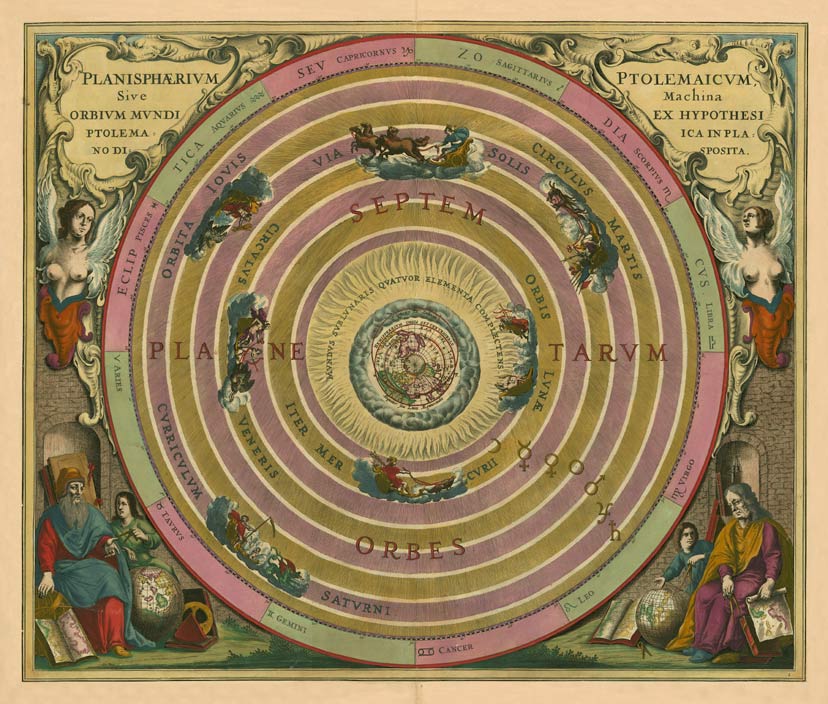
“I will do this by using images of early star maps — those antiquated zodiac symbols and star charts used in the early days of navigating the high seas. By using these, it not only shows the smallness of the earth in relation to the universe, it also shows how the earth has been around for a long time, and makes us feel small by comparison.”
This is the “How” behind your project.
Sure, these star charts could also look “cool” — but the idea is infused with a concept! The aesthetic decisions relate to an angle into the album design. They also challenge us to think about “earth” in a less typical way.
When you give your presentation describing your project, it will be important for you to elaborate upon these details.
Again — think about “what” you will do, and “how” you will do it…
Pre-Concept Non-Linear Idea Generation
(Brainstorming)
So this seems like an easy recipe to follow — just fill in the blanks, right? It can still be challenging to develop new ideas, and take projects beyond typical expectations.
Something you’ve no doubt done before — brainstorming — may be the best way to really push ideas into new territories. Because this process is non-hierarchical, and non-linear, it does allow a lot of experimental ideas to take shape.
In class we’ll try an example together, then you can test out your storm patterns on your subject for this project…
In some ways, the further you get away from the center could be the most interesting terrain for your project. Sure, you don’t want the project out in “left field,” but then again, it does challenge our expectations. (That’s what rock is all about!)
Again, you may need to “reverse-engineer” in order to develop an interesting concept.
Keep in mind that generating a concept is a creative process — just like drawing, painting, or working in Photoshop. In other words, you need to be creative in drawing out connections between images and ideas!
Further Continuing a Solid Concept
(or the secret life of Adjectives)
We’ve seen above how adjectives can be useful in developing concepts. This is not exclusive domain, but these sorts of “descriptive” words can really make a project.
Why is that?
Is it that they spark the imagination? They evoke past experiences? Perhaps between nouns and verbs they instill qualities and characteristics which capture our attention?
Whatever the case may be, don’t neglect the power of these words. We’ll try an experiment to see how creative you can be in making connections and developing concepts.
Technical Issues
We’ll use this text:
It was the best of times, it was the worst of times, it was the age of wisdom, it was the age of foolishness, it was the epoch of belief, it was the epoch of incredulity, it was the season of Light, it was the season of Darkness, we had everything before us, we had nothing before us, we were all going to Heaven, we were all going direct the other way — in short, the period was so far like the present period, that some of the noisiest authorities insisted on its being received, for good or for evil, in the superlative degree of comparison only.
And this image:
Milestone Due by Next Class:
“Pitch Statement” uploaded to blog in CI Learn
