Background
No doubt it’s easy to get caught up with the trend toward the “latest of the latest.” Whether it’s a new product from Apple, some new internet meme, a new film, new app, new album – we’re surrounded and obsessed with whatever is new. This project will instead look back on what is old, what’s already happened, and what probably has been forgotten.
We will continue our investigations of the “cut-and-paste” aesthetic through one more project. While the last project used cut-and-paste to evoke “monsters,” this piece will consider the aesthetics of a pre-digital age. You will essentially be creating a portion of a cut-and-paste-style typeface.
Keep in mind that one of our central issues is to use Photoshop as a tool, but also to create work that doesn’t look “Photoshopped.” In other words, we want this work to stand on its own as a compelling design; something that, first and foremost, will draw attention to a specific message.
The Basic Project
Using Photoshop, create a 24” High x 18” Wide type-driven “Public Service Announcement” (PSA) which highlights the importance of a historical event that is not particularly well known. The design should be eye-catching, dynamic, and intriguing from both up close and at a distance.
The Less Basic
 The piece itself will be an oversized type-driven poster that promotes some historical event that might be of public interest.
Think about obscure events – occurrences that are perhaps less commonly known – and consider how you might get an audience interested in your design. You will be assigned a random ten-year span of time, and you are welcome to use (everyone’s favorite) Wikipedia to uncover significant dates and events.
Part of the goal of the project is to create an interesting design, but a large part of the project is being able to tell a story in only a few short words. You are welcome to make contemporary references in order to get your point across – in fact, comparisons between the past and present may actually be a very good way to tell your story. What can you tell me about the year 1867 that I would really care about? Think about how you get people interested. You’ve got to lure in your audience – how will you do it?
The Concept
In order to get interest and attention about your important historical event, it’s likely that you will need to present it in some clever way. Both the visuals and text will need to have a hook – a “headline-esque quality” that catches the eye. You can’t just create a poster that says the date and the event – your piece needs a bit of intrigue in order to get people to look.
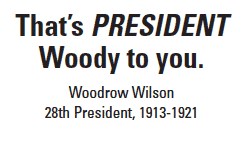
For example, consider the perfectly random year 1913, in which Grand Central Station in New York was built. How do you spark some interest around this bit of trivia?
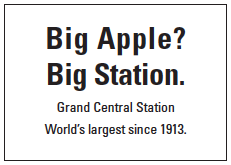
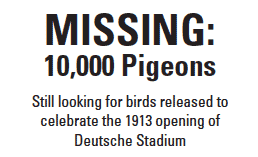
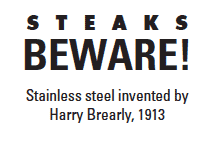
How about some other random events from the same year?
The Catch
There’s always a catch, right? The idea is not to make the project “harder,” but instead to see how you can come up with creative solutions and expand beyond your comfort zone. As you start to work in new ways, your designs will develop a broader aesthetic range. Therefore, pay close attention to these very specific guidelines:
1) A primary component to be featured in the poster will be text, and you must have at least twelve (12) “hand-crafted” letters in your project. This hand-crafted “font” should be the central focus of your poster. There can be additional imagery and elements, but this text should stand out from afar.
2) For the “hand-crafted” words no live text, no font masking (e.g. postcard project), or hand-drawn fonts will be allowed. All text/letters in your piece must be pieced together and CREATED from other existing media. In other words, you can cobble together images, photos, text, or any other media to make actual letters for your poster. The objects, bits, and pieces that you use should hopefully add an additional layer of meaning to your project.
3) Scan or photograph at least 3 images of real-life objects and/or printed materials and incorporate them into the design (scanning is your best bet for high-quality images). Once you have your image, you can distort it, cut it, tweak or reassemble it in any way you like. It’s likely you will create letters from lots of little pieces — the pieces you scan/photograph can have a direct or indirect relationship with your actual subject matter. (Hint: Look around your home, and start looking for books, clothes, plants, etc.).
4) The imagery you use in addition to the custom type (e.g. background and framing) can be intact, it can be cut-and-paste, and it can be integrated however you like. Seeing as there is no guarantee you will find the exact images you want, you may need to do some cutting and pasting to tell your story. The imagery you use does NOT need to be from the time period you are depicting (i.e. you could use scans from the latest issue of Thrasher magazine to create a piece about the presidency of Dwight D. Eisenhower).
Deadlines
Note: milestones are subject to change.
- TUE 02/25: Three concept sketches
- TUE 03/04: Digital Checkpoint
- THU 03/06: Mini Group Critique
- TUE 03/11: Final Critique
